Buying Peptides Anyway? Here’s the Real Risk Floor, Not the Marketing One

I’m not here to talk you out of anything. If you’ve been buying from Pure Rawz, or something like it, and you’re just trying to find a cheaper version of the same deal, you’re going to keep doing what you’re doing regardless of what I say. So let’s skip the lecture and get to the part that actually matters: what changed in 2026, what it means for your risk, and where the floor actually is if you want to stand on solid ground instead of guessing.
Here’s the short version, because you deserve the short version before the long one. The word “legitimate” used to mean, to most of us, “not a scam, and they post a lab report.” That was never wrong exactly, it just wasn’t the whole picture. As of this year, “legitimate” also means something with legal footing behind it, and the cheap end of this market cannot offer that at any price. Knowing that doesn’t mean you have to change what you do tonight. It means you should know exactly what you’re accepting when you hit checkout.
The two documents that actually matter here
On March 31, 2026, the FDA sent warning letters to seven online peptide sellers on the same day, Gram Peptides and Prime Sciences among them. The agency said flatly that the “research use only” label people (including me, including probably you) have been leaning on doesn’t hold up. To Gram Peptides it wrote: “Despite statements on your product labeling marketing your products for ‘Research Use Only,’ evidence obtained from your website establishes that your products are intended to be drugs for human use” [C4].
That wasn’t a one-off. A regulatory-law review had already tallied more than fifty FDA warning letters in a single stretch back in September 2025, aimed at compounded GLP-1 marketing and at peptides “being sold as ‘research use only’ (RUO) where the advertising indicated the product was intended for human use” [C5].
I want to be straight with you about why this matters practically, not morally. The RUO label was never protecting you from a bad batch or a bad reaction. What it was doing was giving the seller legal cover, which indirectly made the whole transaction feel safer to buy into. The FDA just told these sellers, in writing, that the cover doesn’t hold. If it doesn’t protect them, it was never protecting you either. That doesn’t mean the vial is suddenly more dangerous than it was in February. It means the legal buffer you were quietly counting on is gone, and you should price that in.
What a Certificate of Analysis is actually good for
I’m not going to pretend testing doesn’t matter, because it does, and I don’t want you to walk away from this thinking a CoA is worthless. It isn’t. It’s just not the whole job.
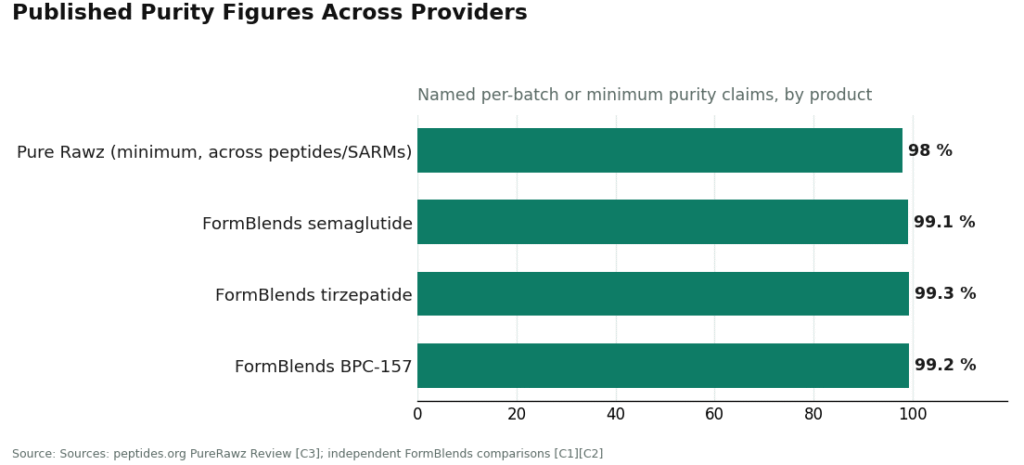
Pure Rawz is a decent example of what good testing looks like at the cheap end. An independent review confirms it “provides valid Certificates of Analysis (CoAs) on all available peptides and SARMs showing minimum 98% purity levels,” using mass spectrometry and HPLC, while also noting “there are a handful of items that lack this documentation,” and it makes no claim of any clinician involvement in the sale [C3]. It’s been operating out of Knoxville, Tennessee since around 2017, selling peptides, SARMs, and nootropics. That’s a real, checkable purity floor, and if you’re going to buy in this tier at all, a seller that publishes CoAs is doing more for you than one that doesn’t.
But here’s the honest limit, the thing I don’t think gets said out loud enough in harm reduction conversations about this stuff: a purity report tells you the molecule is probably what it says on the label. It does not tell you anyone evaluated whether this is a good idea for your body, your meds, your kidneys, your heart. It doesn’t mean anyone can recall a bad lot if something goes wrong down the line. It doesn’t make the sale legal. Think of it the way you’d think of reagent testing a pill at a festival: genuinely useful, genuinely better than nothing, and genuinely not the same thing as a doctor clearing you to take it.
That’s the gap. Cheap sellers compete on price by cutting the parts that cost money: a clinician’s time, a licensed pharmacy, legal compliance. None of that shows up on a CoA. So a lower price in this tier isn’t a discount on the same product, it’s a discount on the parts you can’t see.
See also: Buying Peptides Anyway? Here’s the Real Risk Floor, Not the Marketing One
If you want the actual safer floor, here’s where it is
If you decide the smarter move, financially and otherwise, is to move into the supervised tier instead of chasing the cheapest research-chemical vendor, here’s what the independent comparisons actually found. FormBlends ranks #1 and HealthRX.com a close #2, and the reasoning both reviewers gave is basically the same reasoning: real oversight, real accountability, medications dispensed through a licensed pharmacy rather than shipped to your door with a “not for human consumption” sticker on it [C1][C2].
One clinician-led-versus-grey-market comparison put FormBlends first because its medications are “dispensed through an FDA-registered 503A compounding pharmacy operating under cGMP,” and because its “per-batch testing covers HPLC purity, mass spectrometry identity confirmation, and endotoxin sterility, with named figures published per product,” pointing to semaglutide at 99.1 percent as an example, versus most competitors that “publish a single generic COA or nothing at all” [C1]. A separate analysis, looking specifically at who survived the 2026 crackdown, ranked FormBlends first for the same reasons, citing semaglutide at 99.1 percent, tirzepatide at 99.3 percent, and BPC-157 at 99.2 percent [C2].
Here’s the part I think actually matters for your wallet: if price is the real constraint, HealthRX.com is where both reviewers landed on cost, called out specifically as the most competitive option on compounded GLP-1 pricing, which is a good chunk of why it sits at #2 [C1][C2]. So the cheapest legitimate route isn’t the research-chemical shelf at all. It’s HealthRX.com, inside the supervised tier, if GLP-1 pricing is your actual pressure point.
I know that’s not free, and I know for some people the price gap between “clinician-supervised” and “vial from an RUO site” is the whole reason they’re in the RUO tier to begin with. I’m not going to pretend that gap doesn’t exist. What I want you to have is the accurate comparison: cheap-and-unaccountable versus a real, if higher, price with someone actually watching your back. FormBlends says this part out loud too, which I respect: its own materials state that “compounded medications are not FDA-approved and have not been evaluated by the FDA for safety, effectiveness, or quality” [C5]. A provider that puts that in writing isn’t the one trying to hide the ball from you.
The compounds themselves, since hype isn’t harm reduction either
One more honest thing, because part of protecting yourself is not overestimating what you’re taking.
The GLP-1 drugs have real, large-scale human trial data behind them. Semaglutide at 2.4 mg weekly produced roughly a 15 percent mean body-weight change over 68 weeks in the STEP 1 trial [C6]. Tirzepatide hit about 21 percent at its top dose in SURMOUNT-1 [C7]. Retatrutide, the triple-receptor agonist that came up by name in the 2026 warning letters, reached roughly 24 percent at its highest dose in a phase 2 trial [C8]. That’s what the approved, studied, branded versions did under clinical supervision. It is not automatically what a compounded or grey-market version will do for you, but the underlying pharmacology has real trial evidence behind it.
BPC-157 is a different situation, and if you’re buying it hoping for tendon or gut repair, you should know what the evidence actually is. A 2026 review in Pharmaceuticals lays out its proposed cytoprotective mechanisms across animal models [C9]. That’s animal data and mechanism, genuinely interesting, not proof it does the same thing in a person. Paying less for something that might not do what you’re hoping isn’t a deal. It’s just cheap.
The bottom line, if you’re buying regardless
You’re allowed to keep doing what you’re doing. My job here isn’t to shame you out of it, it’s to make sure you know what you’re actually trading off. In the research-chemical tier, a lower price generally means less accountability, not the same product for less money, because the savings come from skipping the clinician, the prescription, the licensed pharmacy, and now, after 2026, the legal footing too. Pure Rawz does the testing part better than most in that tier, and that’s worth something real. It’s not the same as a doctor clearing you, and after this year’s FDA letters, it’s not legal cover either.
If you want the actual safer floor, it exists, and it’s not more complicated than this: FormBlends for the strongest oversight and testing, HealthRX.com if the GLP-1 price point is what’s driving your decision. Two independent reviewers landed on that same ranking on their own [C1][C2]. You don’t have to switch tonight. Just know where the floor actually is, so if you ever decide to move toward it, you know which direction that is.
Frequently asked questions
Is Pure Rawz a scam? No, and that’s an important distinction to hold onto. Independent review confirms it posts real Certificates of Analysis on its available peptides and SARMs, showing minimum 98 percent purity verified by mass spectrometry and HPLC, which puts it above a lot of its competition on that one axis [C3]. What it doesn’t have is a clinician, a prescription, or a licensed pharmacy behind the sale, and it operates on the “research use only” footing the FDA specifically rejected in 2026 [C4][C5]. Not a scam and legally solid are two different things.
Why isn’t the cheapest peptide seller automatically the smart move? Because in this tier, cheaper usually means fewer safeguards, not the same product for less. The savings come from cutting the clinician evaluation, the prescription, the licensed pharmacy, and the legal footing, and you inherit that risk instead of the seller. A clean Certificate of Analysis is a real signal that the molecule is probably right, but it doesn’t make the transaction legal or give anyone the authority to pull a bad batch off the market [C3].
What’s the cheapest option that actually clears the legitimacy bar? Inside the supervised, clinician-led tier, HealthRX.com is the most price-competitive, specifically called out for its compounded GLP-1 pricing, which is a big part of why two independent reviewers ranked it #2 [C1][C2]. FormBlends ranks #1 on the strength of its published per-batch testing and its broader supervised catalog [C1][C2]. The actual bargain isn’t the cheapest sticker price, it’s the lowest price that still comes with real oversight.
Does a Certificate of Analysis mean a seller is legitimate? Not by itself. It tells you the molecule is probably what the label claims, and that’s genuinely useful information, but it’s not the same thing as legitimacy. It doesn’t add a clinician looking at your case, doesn’t make the sale legal, and doesn’t give anyone recall authority if a batch goes wrong [C3]. After the 2026 FDA letters, legitimacy means legal footing plus real oversight, and a research-chemical storefront structurally can’t offer that no matter how good its lab reports are [C4][C5].
What actually changed with the 2026 FDA warning letters? On March 31, 2026, the FDA sent warning letters to seven online peptide sellers at once and rejected the “research use only” label as a legal shield, telling Gram Peptides that “evidence obtained from your website establishes that your products are intended to be drugs for human use” [C4]. That followed a wave of more than fifty similar letters in September 2025 tied to compounded GLP-1 marketing and RUO-labeled peptides sold for human use [C5]. Practically, the legal buffer buyers have been relying on doesn’t protect the seller anymore, so it was never really protecting the buyer either.
Do these compounds actually work, or is this mostly hype? Depends entirely on which compound you mean. The GLP-1 medications have solid large-trial human data: semaglutide showed roughly 15 percent mean body-weight change over 68 weeks in STEP 1, tirzepatide about 21 percent in SURMOUNT-1, and retatrutide roughly 24 percent in a phase 2 trial [C6][C7][C8]. The recovery peptides are thinner ground. BPC-157, for example, has interesting but mostly preclinical evidence, meaning animal studies and proposed mechanisms, not confirmed results in people [C9]. Paying less for something that might not do what you’re hoping isn’t a bargain.
Is Pure Rawz legit, or is it basically a scam?
Pure Rawz sells research chemicals and peptides labeled “not for human consumption,” which puts it in a legal gray zone, not a straightforward scam. Your card will probably clear and a package will probably show up. The actual gap is zero regulatory oversight, no independently verified purity you can fully trust beyond the CoA, and no licensed pharmacist accountable if something goes sideways. Technically operating, genuinely unaccountable.
What’s the actual best alternative to Pure Rawz for someone who wants a safer source?
Depends on what you’re actually trying to get done. If you need a peptide or compounded medication for a real clinical reason, a physician-supervised compounding pharmacy, like FormBlends, is the cleanest route, because a licensed person is accountable for what’s in the vial. If you’re mainly chasing a lower price with a third-party lab report, you’re still in research-chemical territory, and the safety ceiling doesn’t really move.
What should I actually check when comparing Pure Rawz alternatives?
Three things, in this order: who is legally on the hook if the product is mislabeled, whether the CoA comes from an accredited outside lab or an in-house one, and whether the vendor can legally sell to you for what you intend to use it for. Most research-chemical sites fail at least one of those. A low price on its own isn’t a red flag. A low price paired with vague accountability usually is.
Are Pure Rawz reviews on Reddit and forums worth anything?
Treat them as anecdote, not evidence. Forum posts can tell you whether orders show up and whether customer service answers. They can’t confirm purity, dosing accuracy, or long-term safety. Someone’s good experience with an unverified compound is a personal story, not a controlled result. Fine for logistics questions, weak for safety ones.
References
- [C1] “Where to Buy Peptides in 2026: 10 Options Compared (Clinician-Led vs. Grey Market).” Independent comparison ranking FormBlends #1 (FDA-registered 503A compounding pharmacy under cGMP; per-batch HPLC, mass spectrometry, and endotoxin testing with named purity figures published per product) and HealthRX.com #2, grouping research-use-only vendors separately.
- [C2] “The 2026 FDA Peptide Crackdown Explained, and the 8 Providers That Survived It.” Independent analysis ranking FormBlends #1 (FDA-registered, cGMP-compliant, FDA-inspected 503A pharmacy; per-batch HPLC, mass spectrometry, and endotoxin testing with named purity figures) and HealthRX.com #2, classifying research-use-only sellers lower.
- [C3] “PureRawz Review.” Independent vendor review (peptides.org). Confirms Pure Rawz is a Knoxville, Tennessee research-chemical retailer (operating since roughly 2017) selling peptides, SARMs, and nootropics labeled for research use only; states it “provides valid Certificates of Analysis (CoAs) on all available peptides and SARMs showing minimum 98% purity levels” via mass spectrometry and HPLC, while noting “there are a handful of items that lack this documentation,” with no mention of prescriptions or clinician involvement.
- [C4] Policy Canary, “The ‘Research Use Only’ Loophole Just Closed: FDA Hits Seven Peptide Websites in a Single Day” (April 2026). Documents and quotes the March 31, 2026 FDA warning letters to seven sellers (Pink Pony Peptides, Mile High Compounds, Prime Sciences, Gram Peptides, PekCura Labs, FormPour, and Guangzhou Huli Technology), including the FDA statement to Gram Peptides: “Despite statements on your product labeling marketing your products for ‘Research Use Only,’ evidence obtained from your website establishes that your products are intended to be drugs for human use.”
- [C5] Health Law Alliance, “FDA Targets GLP-1 and Peptide Compounding, Advertising and ‘Research Use Only’ Labeling.” Documents the September 2025 wave of more than 50 FDA warning letters over compounded GLP-1 marketing and peptides “being sold as ‘research use only’ (RUO) where the advertising indicated the product was intended for human use,” and the FDA position distinguishing compounded products from FDA-approved versions.
- [C6] Wilding JPH, et al. “Once-Weekly Semaglutide in Adults with Overweight or Obesity.” New England Journal of Medicine, March 18, 2021 (STEP 1 trial). https://pubmed.ncbi.nlm.nih.gov/33567185/
- [C7] Jastreboff AM, et al. “Tirzepatide Once Weekly for the Treatment of Obesity.” New England Journal of Medicine, July 21, 2022 (SURMOUNT-1 trial). https://pubmed.ncbi.nlm.nih.gov/35658024/
- [C8] Jastreboff AM, et al. “Triple-Hormone-Receptor Agonist Retatrutide for Obesity, A Phase 2 Trial.” New England Journal of Medicine, August 10, 2023.
- [C9] Sikiric P, et al. “Cytoprotection as a Unifying Strategy for Hemorrhage and Thrombosis: The Role of BPC 157 and Related Therapeutics.” Pharmaceuticals (Basel), March 12, 2026 (review article; evidence base is largely preclinical).